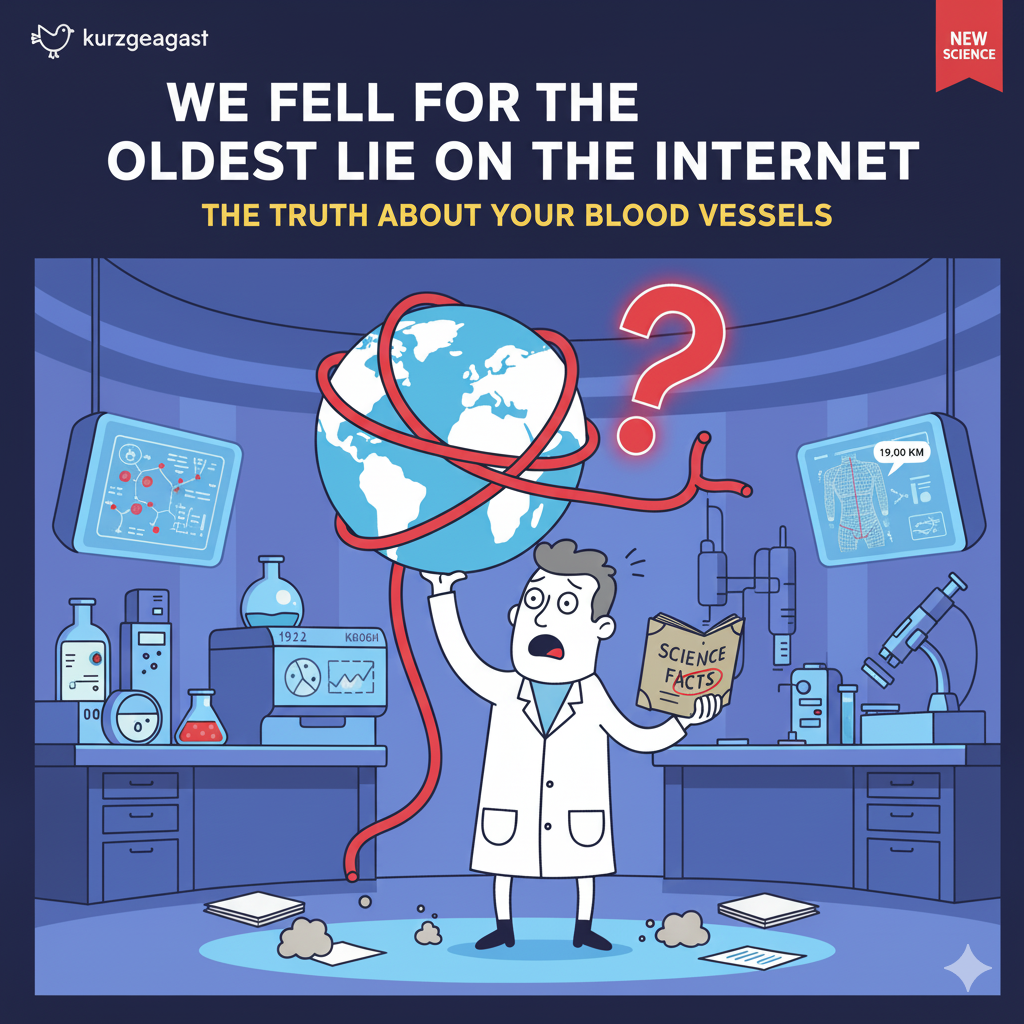
You’ve probably heard this one before:
“If you laid out all the blood vessels in your body end to end, they’d stretch 100,000 kilometres – enough to circle the Earth twice.”
Sounds amazing, doesn’t it?
It’s also completely wrong.
In their video “We Fell For The Oldest Lie On The Internet,” the team at Kurzgesagt – In a Nutshell spent a year chasing down the origins of this so-called “fun fact.” What they found was a perfect case study in how misinformation can quietly take root – even in science.
The Investigation Begins
The 100,000 km claim is everywhere – textbooks, websites, even classrooms. But when Kurzgesagt tried to find where it came from, they hit a dead end.
No research papers.
No original measurements.
Just endless repetition.
When they checked medical databases like PubMed, the number didn’t appear in a single scientific study. That was their first big clue: something wasn’t right.
Digging further, they found references to the claim in the 1990s, in works by science writers David Suzuki and Steven Vogel. But when they reached out to Suzuki, he couldn’t even remember where he’d first seen the number – despite publishing it over 30 years ago.
So the team went through all 93 references in Vogel’s book. And that’s when they got “stupidly lucky.”
The Real Source of the Myth
Their search finally led to a 1959 Scientific American article – which in turn cited a 1922 book called The Anatomy and Physiology of Capillaries by August Krogh, a Nobel Prize–winning physiologist.
Here’s the twist:
Krogh wasn’t estimating all blood vessels. He was only talking about capillaries, and his total came to roughly 100,000 kilometres.
But there were two problems:
- His estimate was based on a 50 kg body made entirely of muscle.
- Later studies found his assumptions about capillary density were way off.
In other words, what began as a rough guess from a respected scientist turned into a “scientific fact” that no one ever bothered to question – for nearly a century.
So What’s the Real Number?
While Kurzgesagt was working on their video, a new study came out with a far more realistic estimate:
🧬 The total length of all capillaries in the human body is between 9,000 and 19,000 kilometres – not 100,000.
That’s still mind-blowing, but it’s nowhere near enough to wrap around the Earth.
Why the Myth Survived
The video ends with a reminder of why this false “fact” lasted so long:
- Fact-checking is hard. Tracing claims through decades of books takes real effort.
- Big, round numbers stick. “100,000” sounds elegant, simple, and satisfying.
- Amazing stories spread. When something feels incredible, people want to share it – not question it.
A Lesson for All of Us
This story isn’t really about blood vessels – it’s about how easily a catchy claim can outlive the truth. Even smart, well-meaning people fall for neat-sounding “facts” that just feel right.
In a world full of viral science tidbits and recycled trivia, Kurzgesagt’s year-long investigation is a gentle but firm reminder:
Curiosity isn’t just about learning. It’s about questioning.
📺 Watch the full video here:
We Fell For The Oldest Lie On The Internet