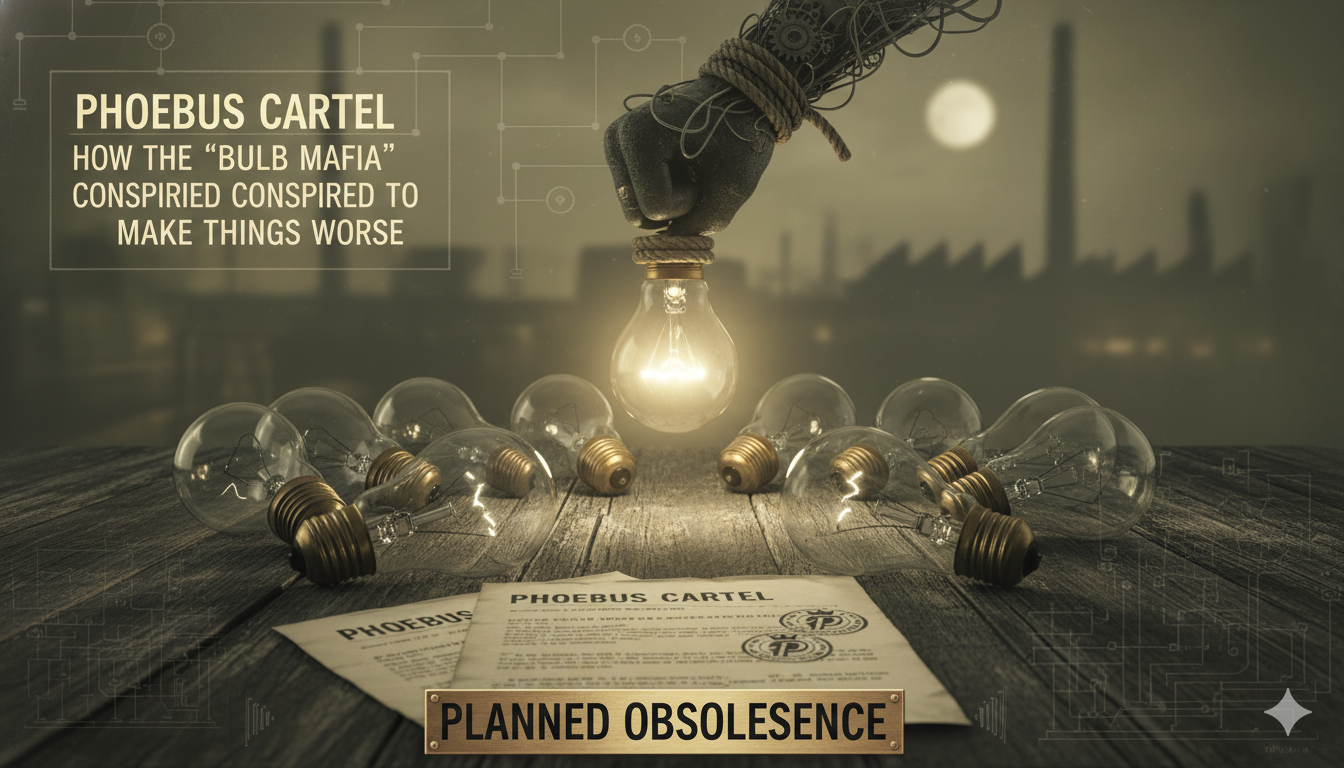
The Light Bulb That Lasted Forever
Imagine buying a light bulb that lasts for decades. In the early 1900s, this kind of extreme durability was surprisingly common. Some light bulbs easily lasted between 2,000 and 2,500 hours. The famous Centennial Bulb in Livermore, California, is the ultimate proof: it has been glowing for over 120 years since it was installed in 1901.
But for the world’s biggest light bulb companies, a product that never wears out is a disaster for business. If bulbs last too long, people stop buying new ones, and profits begin to drop. This sales worry, exemplified by companies like Osram seeing their sales plummet, prompted a drastic, secret reaction.
A Secret Meeting in Geneva
To solve this “problem” of durability, the major bulb manufacturers of the world came together in secret. Just before Christmas in 1924, executives met in Geneva, Switzerland, and formed an illegal group. They named it the Phoebus Cartel, taking its name from Phoebus, the Greek god of light.
This was no small gathering. The cartel was essentially a “Bulb Mafia” that controlled the global market and included industrial giants such as:
- General Electric (GE) from the USA
- Osram from Germany
- Philips from the Netherlands
- Compagnie des Lampes from France
- Associated Electrical Industries (AEI) from the UK
- Toshiba from Japan
The Thousand Hour Rule
The cartel’s core mission was simple and shocking: force all member companies to reduce the life of their light bulbs to a maximum of exactly 1,000 hours.
This limit was written directly into their agreement. They even standardized certain parts, like the screw thread, but the main goal was to standardize a shorter life.
To make sure everyone followed the rules, the cartel established dedicated testing laboratories. Manufacturers had to send samples from their factories to these labs. If a bulb lasted significantly longer than 1,000 hours, the company that made it was heavily fined. Records show companies were penalized (for instance, 200 Swiss Francs for every thousand bulbs sold if their product lasted over 3,000 hours). They were literally fined for making a product that was too good.
Engineered to Fail
Engineers who had spent years extending bulb life were now tasked with doing the opposite. They had to redesign the filaments with thinner wires and different connections to ensure the bulbs would die predictably after 1,000 hours.
This conspiracy is known as the world’s most famous case of planned obsolescence, where a product is intentionally designed to have a limited lifespan to encourage replacement sales.
The reason was pure profit:
- Shorter life meant more frequent replacements.
- More replacements meant a massive increase in sales. Cartel members saw sales rise by 25% in the years immediately following 1926.
- They also maintained high prices, even as manufacturing costs dropped, maximizing their profit margins.
How It Ended
The Phoebus Cartel operated successfully from 1924 to 1939, but two major events eventually led to its collapse:
- World War II: The global conflict disrupted international communication, making it impossible to enforce the cartel’s agreements and collect fines.
- Government Regulation: Governments around the world began to strengthen their laws against monopolies and illegal collusion.
The cartel dissolved, but the business model of planned obsolescence survived, influencing how countless consumer goods are designed even today.
Fun Fact
The Centennial Light Bulb, installed in 1901, is still glowing in a California firehouse. It shows the incredible durability that was possible before the Phoebus Cartel stepped in to standardize shorter lives.

Inspiration for this post: This blog post was inspired by the detailed historical deep dives found in the following YouTube videos: