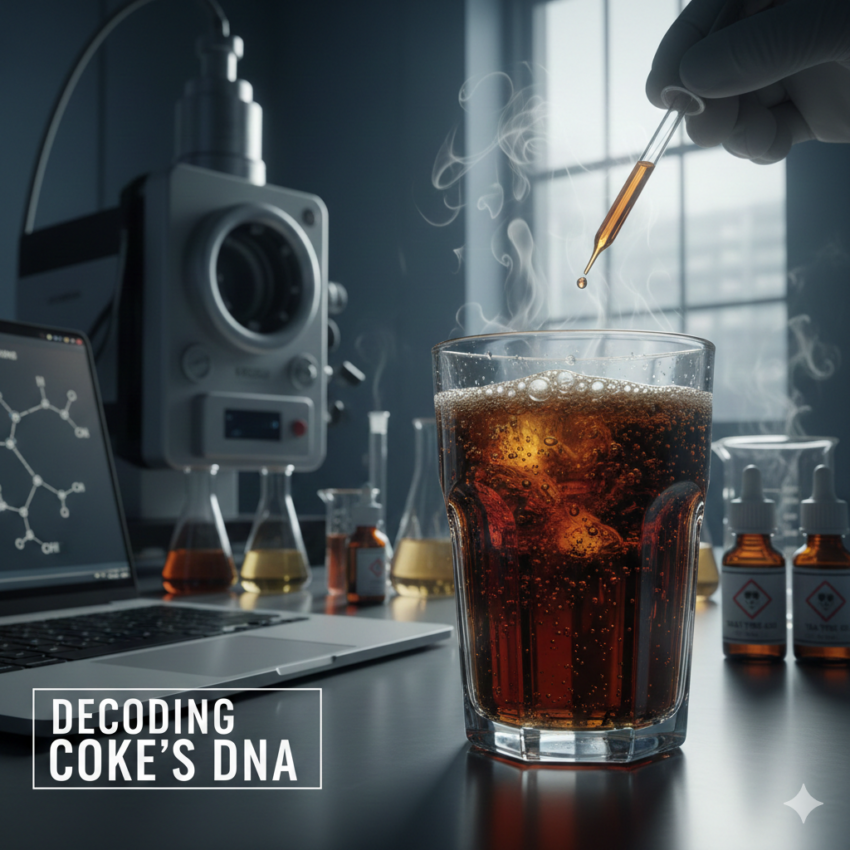
For over 130 years, the recipe for Coca-Cola has been one of the world’s best-kept secrets. It’s famously locked in a vault in Atlanta, and legend says only two people know it at any given time.
But you can’t hide molecules from a scientist.
A creator from the YouTube channel LabCoatz spent a year using high-tech lab equipment and a professional research paper to “read” the molecules inside a bottle of Coke. He didn’t just guess the recipe—he used chemistry to prove it.
How do you “read” a flavor?
The creator used a technique called Mass Spectrometry.
Imagine you have a finished Lego castle, but you don’t have the instructions. A mass spectrometer essentially “smashes” the castle into individual bricks and weighs them. By knowing the weight of the “bricks” (molecules), scientists can tell exactly what went into the drink.
What the “DNA Test” Revealed:
- The “No Clove” Rule: Many old recipes use clove oil. The lab test showed that the chemical for cloves (Eugenol) was barely there. It turns out that adding cloves is why most homemade colas taste like a “holiday candle” instead of a soda.
- The Vinegar Secret: The most shocking discovery was Acetic Acid (vinegar). It was the third most common flavor molecule found. You don’t taste “sour vinegar” when you drink a Coke, but those tiny drops help balance the heavy sugar and give it a “bright” smell.
- The “Green” Taste: Real Coke uses a special leaf extract (the cocoa leaf). Since regular people can’t buy that, the creator found that Tea Tree Oil and Wine Tannins (the stuff that makes your mouth feel dry when drinking tea) could replicate that fresh, earthy “bite.”
The Big Secret: “Cook the Syrup”
Most people think you just stir the ingredients together. The science showed that’s wrong.
To get the real taste, you have to heat the mixture. When you heat sugar, water, and acid together, they “talk” to each other chemically. This “mellows out” the sharp citrus oils and blends them into one single “Coke” flavor instead of it tasting like a bunch of separate oils floating in water.
DIY: The “Lab Cola” Recipe
This project is a fascinating look into the world of flavor chemistry, but recreating a “Lab Cola” involves handling concentrated chemicals and industrial ingredients that can be dangerous if misused.
If you are planning to try this at home, please read these safety warnings carefully.
SAFETY WARNING
PROCEED AT YOUR OWN RISK. This project involves handling industrial-grade chemicals and concentrated oils.
- Expertise Required: Do not attempt this unless you have experience handling acids and measuring high-potency ingredients.
- Chemical Safety: Phosphoric acid is corrosive; it can burn your skin and eyes.
- Ingestion Risk: Most essential oils are TOXIC if not labeled specifically as “Food Grade.” Using aromatherapy or craft oils can lead to severe illness or poisoning.
- Measurement Precision: Ingredients like tea tree oil are used in “parts per million.” A single extra drop can make the batch toxic.
1. Essential Oil Safety (The “Internal” Rule)
Most essential oils sold in craft stores or for aromatherapy are not for human consumption. They often contain impurities or synthetic fillers that are toxic if swallowed.
- The Rule: You must use only oils labeled as “Food Grade” or “GRAS” (Generally Recognized As Safe) by the FDA.
- Tea Tree Oil Warning: In its undiluted form, tea tree oil is toxic. The “Lab Cola” recipe uses it in parts per million (literally one drop in a massive batch). Never exceed this amount, and never ingest undiluted tea tree oil.
2. Chemical Handling (Acids)
The recipe calls for Phosphoric Acid, which is a strong mineral acid used in industrial food production.
- Concentration: Lab-grade phosphoric acid (usually 85%) is highly corrosive. It can cause severe skin burns and permanent eye damage.
- The Rule: Always wear gloves and eye protection when handling the acid. Always add acid to water, never water to acid, to prevent splashing or “boiling” reactions.
3. The “Flash Point” (Heating Oils)
Essential oils are highly flammable.
- The Rule: Never add your “7X” flavor oil mixture to a pot that is currently over an open flame. The vapors can ignite. Always remove the syrup from the heat source and let it cool slightly before whisking in your oils.
4. Equipment Contamination
If you use your kitchen pots and spoons to mix high-concentration essential oils (like Cinnamon or Tea Tree), the scent can “stain” your equipment for a long time.
- The Rule: Use glass or stainless steel tools, as plastic will absorb the oils and potentially leach chemicals into your next meal.
The Verified Recipe & Science
The key to this replica isn’t just the list of ingredients—it’s the chemical markers identified by the mass spectrometer at [00:07:32].
1. The “7X” Flavoring (The Oil Blend)
This is the concentrated aroma of the drink. In the video, these are mixed with an emulsifier (like Gum Arabic or Glycerin) so they don’t float on top.
- Orange & Lemon Oils: The “backbone” of the flavor.
- Lime Oil: Adds the sharp, high notes.
- Cassia (Cinnamon) Oil: Provides the “brown” spice profile.
- Nutmeg Oil: Adds warmth and complexity.
- Coriander Oil: Verified by the paper’s “S-linalool” marker. This replaces the floral notes many people wrongly think are in Coke.
- Tea Tree Oil: Only a tiny trace (7 parts per million). This provides the “terpinen-4-ol” identified in the lab as the “green/fresh” note of the cocoa leaf.
2. The Water-Based Solution (The Base)
- Sugar & Water: The syrup body.
- Phosphoric Acid: The source of the “bite” and the preservative.
- Acetic Acid (Vinegar): Discovered in the research paper as a top flavor compound. It balances the high sugar.
- Wine Tannins: Mimics the mouth-drying feel of the cocoa leaf.
- Vanilla Extract & Caffeine: For the classic finish and energy kick.
DIY: How to Make “Lab Cola” at Home
Safety Warning: Use only Food Grade essential oils. Craft/scent oils are toxic. The tea tree oil must be used in a microscopic amount (1 drop per gallon of syrup).
Step 1: Create the Flavor Concentrate
Mix the following oils in a small bottle. This makes enough for many gallons.
- Orange Oil: 1.20g
- Lemon Oil: 0.80g
- Lime Oil: 0.40g
- Cassia (Cinnamon) Oil: 0.20g
- Nutmeg Oil: 0.20g
- Coriander Oil: 0.10g
- Tea Tree Oil: 1 drop (be very careful here).
Step 2: Make the Syrup
- Caramelize: Heat a small amount of sugar until it turns dark brown/black to create the color and toasted flavor.
- The Base: In a pot, combine 2 cups of sugar, 1 cup of water, and 1 tsp of Phosphoric acid (or Citric acid if you can’t find it).
- The Secret Balance: Add 1/2 tsp of White Vinegar and a pinch of Wine Tannins (powder).
- Heat: Simmer the mixture for 10 minutes. This “mellows” the flavors—without this step, it will taste like medicine.
Step 3: Combine
- While the syrup is warm, whisk in 1/4 tsp of your Flavor Concentrate from Step 1.
- Add 1 tsp of Vanilla Extract.
- Let it cool completely.
Step 4: Carbonate
Mix 1 part syrup with 5 parts cold sparkling water.
How to “Think Like a Chemist”
To stay safe and get the best result, use the Master Blend method shown in the video at [00:17:39].
By mixing all your oils into a separate “7X Concentrate” first, you ensure that you are only adding tiny, safe amounts to your actual drink. If you try to drop the oils directly into your soda one by one, a single extra drop of cinnamon or tea tree oil will make the drink undrinkable and potentially unsafe.
Sources & Research
- The Video: Perfectly Replicating Coca Cola – LabCoatz
- The Paper: “Characterization of the Key Aroma Compounds in an American Cola Beverage” (Journal of Agricultural and Food Chemistry).
- Key Timestamp for Findings: The “Vinegar/Acetic Acid” discovery is at [00:11:30]. The “Tea Tree/Tannin” breakthrough is at [00:13:07].